Gravity Is the Medium: The Artists Who Paint on Everything Except a Flat Surface
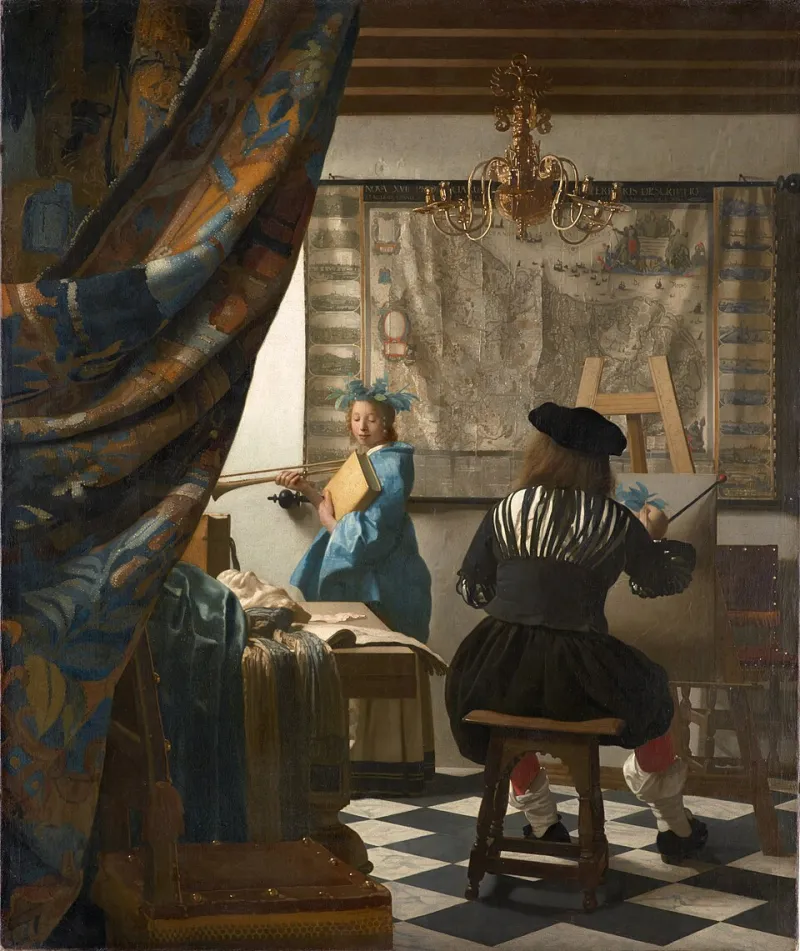
Photo: Johannes Vermeer, Public domain, via Wikimedia Commons
There's a moment — ask anyone who's tried it — when you're crouched on a 40-degree slope with a brush in your hand and paint sliding south before you've even made a decision about it. And instead of panic, something else kicks in. Adaptation. Improvisation. A kind of surrender that ends up looking like genius on the finished piece.
That's the experience a loosely connected community of American artists has been chasing for the better part of a decade, and it's starting to look less like a fringe obsession and more like a genuine movement. These are painters, muralists, and installation artists who've walked away from flat ground — not because it's trendy, but because working on inclined, angled, and tilted surfaces has fundamentally changed how they think about making art.
Why Flat Got Boring (And Physics Got Interesting)
The traditional easel is basically a flat-surface delivery system. It holds your canvas vertical, stable, and cooperative. The floor, the table, the gallery wall — all of them promise predictability. And for a lot of artists, that predictability quietly became a ceiling.
"I kept making the same compositional decisions," says Mara Delgado, a muralist based in Albuquerque who started painting on the angled concrete drainage channels that run through the Southwest. "Flat surfaces tell you where the top is, where the bottom is. You follow that logic without even realizing you're doing it. The moment I started working on a slope, I had no idea where anything was supposed to go. That disorientation was the most creative thing that ever happened to me."
Delgado isn't alone in that diagnosis. Across the country, from the hillside neighborhoods of Los Angeles to the rocky gorges of Appalachia, artists are seeking out surfaces that fight back. Rooftops with pitched angles. Skateboard ramps. Highway overpasses. The sloped concrete walls of flood control channels. Even the sides of grain silos, where the gentle curve turns any straight line into a subtle arc.
The common thread isn't aesthetic — the work these artists make looks wildly different from one another. The common thread is physics. Specifically, what happens when gravity becomes a collaborator you can't ignore.
When Paint Moves Before You Do
Working on an inclined surface changes the behavior of every material you use. Acrylic runs faster than you expect. Oil paint pools at the low edge. Spray paint drifts in directions that would never occur on a vertical wall. Chalk and charcoal smear downward under the lightest touch.
For some artists, this is the whole point.
Jordan Fitch, a process-based painter out of Pittsburgh, has spent three years working almost exclusively on ramps — first borrowed skateparks, then purpose-built wooden inclines in his studio. He documents each piece with time-lapse footage, and watching it back, you can see the paint making decisions. Drips that start as accidents resolve into structural lines. Pooling creates gradients that no brush could replicate.
"I stopped thinking of the material as something I was applying and started thinking of it as something I was releasing," Fitch says. "You set conditions. Then you get out of the way. The slope does the rest."
This isn't laziness. Setting conditions on an inclined surface requires an entirely different kind of technical knowledge — an understanding of viscosity, drying time, and the physics of flow that most art school curricula don't bother to teach. Fitch has notebooks full of experiments: what happens to a specific paint brand at a 25-degree angle versus a 45-degree one. How humidity affects the behavior of poured resin on a slope. Which pigments separate and which hold together when they're given room to run.
The Body in the Work
There's another dimension to all of this that's harder to quantify but impossible to ignore: what working on a slope does to the artist's body, and how that physical experience ends up embedded in the finished piece.
Flat surfaces let you step back, reassess, stand comfortably. Inclined surfaces demand constant physical negotiation. You're bracing, shifting weight, reaching uphill and crouching downhill. Your arm moves differently when you're working against gravity. Your brush strokes have a different quality when your shoulder is compensating for a 30-degree lean.
Sadie Okafor, an installation artist who creates large-scale works on the sloped concrete faces of retaining walls in the Hudson Valley, talks about this in terms of what she calls "effort marks" — the places in a piece where the physical challenge of making it is visibly present.
"When you look at a painting made on flat ground, you're seeing the artist's decisions," she says. "When you look at something made on a steep surface, you're seeing the artist's decisions AND their body. The struggle is in there. The adaptation is in there. I think viewers feel that even when they don't know what they're responding to."
Okafor's retaining wall pieces — sweeping, abstract works that can run 60 feet across a single inclined face — have a kinetic quality that's hard to pin down until you've watched her make them. She works from a harness on some sections, free-standing on others, and the shift between those modes is visible in the work if you know to look for it.
The Logistics Nobody Talks About
It would be dishonest to romanticize all of this without acknowledging that working on non-horizontal surfaces is genuinely, sometimes brutally, inconvenient.
Paint supplies don't stay where you put them. Ladders behave differently on uneven ground — something this site knows a thing or two about. Buckets tip. Reference photos slide. Your knees ache in ways they don't when you're standing on flat concrete. The physical toll of a long day on a slope is different from a long day at an easel, and not always in a fun way.
Fitch laughs when he talks about the first year of working on ramps. "I destroyed so much paint. I slipped and put my hand through pieces that weren't dry yet. I lost a whole roller down a drainage channel once. It takes a while before you stop fighting the conditions and start working with them."
That learning curve, though, seems to be part of what makes the work matter to these artists. The inconvenience isn't incidental — it's the whole experiment.
What the Work Knows That the Artist Doesn't
There's a philosophical undercurrent to this movement that goes beyond technique. These artists are, collectively, making an argument about control — specifically, about what happens to creative work when you deliberately give some of it up.
Flat surfaces are about mastery. You apply what you know. You execute your vision. The surface cooperates.
Inclined surfaces are about negotiation. You bring your vision, the surface brings physics, and something emerges from the conversation that neither party could have produced alone.
For a lot of artists, that negotiation is producing the most interesting work of their careers. The compositions are stranger. The marks are more alive. The finished pieces carry a legible history of their own making.
Mara Delgado puts it simply: "Flat ground makes you the author. A slope makes you a collaborator. And honestly? The slope has better ideas than I do."
Somewhere out there, paint is running downhill right now, making a decision no artist planned for. And if you're lucky enough to be watching, it probably looks like something you've never seen before.