When the Body Becomes the Brushstroke: What Painting from Precarious Places Does to Your Art
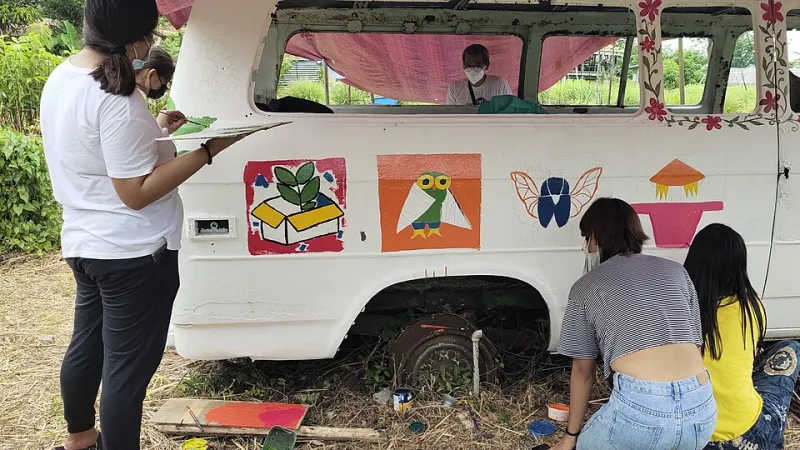
Photo: Irvin Parco Sto. Tomas, CC BY-SA 4.0, via Wikimedia Commons
There's a particular kind of mark that only happens when your shoulder is screaming, your foot is wedged against a rung, and you've got about four seconds before your arm gives out. It's not a planned mark. It's not the mark you practiced in your sketchbook at the kitchen table. It's the mark your body negotiates with the wall when all the comfortable options are gone.
For a growing number of artists across the US, that negotiation is the whole point.
The Studio Lie We've All Bought Into
We've been sold a pretty specific image of what making art looks like. Clean light. Flat surface. Maybe a stool. The artist in total control, executing a vision with calm precision. It's a nice story. It's also, for a lot of working painters and muralists, complete fiction.
"The studio is a fantasy," says Denver-based muralist Priya Okafor, who has spent the better part of a decade painting large-scale work on building exteriors across the Mountain West. "The minute you get on a ladder — like, actually on one, not posing next to one — everything you thought you knew about your process gets renegotiated. Your reach is finite. Your angle is fixed. The painting makes decisions for you, and at first that feels like failure. Then it feels like collaboration."
Okafor's large-format work is immediately recognizable for its loose, sweeping gestures and a quality she calls "earned imprecision" — marks that look spontaneous because they genuinely were, born out of the physical reality of working at height with a loaded brush and nowhere comfortable to stand.
Constraint as Vocabulary
The idea that limitation breeds creativity isn't new. Writers use strict forms. Musicians work within time signatures. But visual artists, especially painters, often resist the idea that their physical circumstances belong in the conversation about aesthetics. The body is supposed to be a neutral delivery system for the mind's vision. Except it isn't. It never was.
Chicago-based painter and installation artist Marcus Vell has spent years deliberately engineering constrained working conditions for himself — not just ladders, but scaffolding at angles, suspended platforms, working upside-down when the project calls for it. His studio looks less like a painting space and more like a low-budget film set.
"I started doing it almost as a stunt," he admits. "Like, what happens if I make it harder? But then I noticed my work getting more honest. Not more skilled, necessarily. More honest. The shapes I was making were shapes I couldn't have made any other way. They had a kind of biological logic to them. My body's limits were writing themselves into the painting."
Vell talks about developing what he calls a "positional vocabulary" — a set of marks and gestures that belong specifically to certain physical positions. There are things he can only make from a particular angle on the third rung. There are color decisions he makes differently when he's reaching above his head versus working at chest height. None of it was planned. All of it is now intentional.
The Awkward Angle Doesn't Lie
There's something worth sitting with here: why does constraint produce honesty? Part of the answer is neurological. When you're physically uncomfortable or working at the edge of your balance, the part of your brain that overthinks and second-guesses has less bandwidth. The internal critic quiets down because it's busy keeping you upright.
Portland muralist and community arts educator Sasha Delaney describes it as "getting out of your own way by force."
"I've watched students completely transform when I take them off flat surfaces," Delaney says. "They stop trying to make something good and start trying to make something real, because good feels impossible when you're balancing on a step ladder in a parking lot. Real is the only option you've got."
Delaney runs workshops specifically designed around working in awkward, non-studio conditions — painting on fences, on the sides of dumpsters, on curved surfaces in public spaces. The work that comes out of those sessions, she says, consistently outpaces what the same students produce in controlled environments. "The constraint strips away the performance of making art. What's left is just the actual art."
Reach, Risk, and the Decisions You Can't Take Back
There's also something about the irreversibility of working at height and at reach that changes decision-making in ways that matter aesthetically. When you're perched somewhere awkward, you can't hover over a mark the way you can at an easel. You commit or you don't. That commitment — the willingness to make a permanent mark under imperfect conditions — shows up in the work.
Okafor talks about a specific mural in Albuquerque where a section of sky went wrong by every technical measure. "I was overreached, my wrist was at a bad angle, I applied way too much paint. By studio logic it's a mistake. By every other logic it's the best part of the painting. People stop in front of it. I don't know exactly how to explain what happened, but the difficulty of making it is somehow visible in it. People feel that."
This is the argument these artists are quietly making: that the trace of physical struggle in a painting isn't a flaw to be corrected. It's information. It's evidence of a real human body working in real space, and viewers respond to it even when they can't name what they're responding to.
Embracing the Rung
None of this means that working on a ladder automatically makes your art better. Plenty of awkward paintings are just awkward paintings. The shift these artists describe isn't about suffering for your work in some romantic, self-punishing way. It's about being genuinely present to the conditions you're working in — letting those conditions participate in the outcome instead of fighting them back toward a predetermined vision.
"The ladder isn't the enemy of the painting," Marcus Vell says. "It's a co-author. Once I stopped treating it like an obstacle and started treating it like a collaborator, everything opened up."
That reframe — from obstacle to collaborator — is maybe the most useful thing any artist working in constrained conditions can carry. Your reach has an edge. Your balance has a limit. Your body has opinions about what it will and won't do comfortably. Those aren't problems to solve before the real work begins.
They are the real work.
And if you're lucky — if you're paying attention — the mark you make in the four seconds before your arm gives out is the one that makes the whole painting.