Slip, Spill, Transcend: The Beautiful Chaos Artists Learn to Stop Fighting
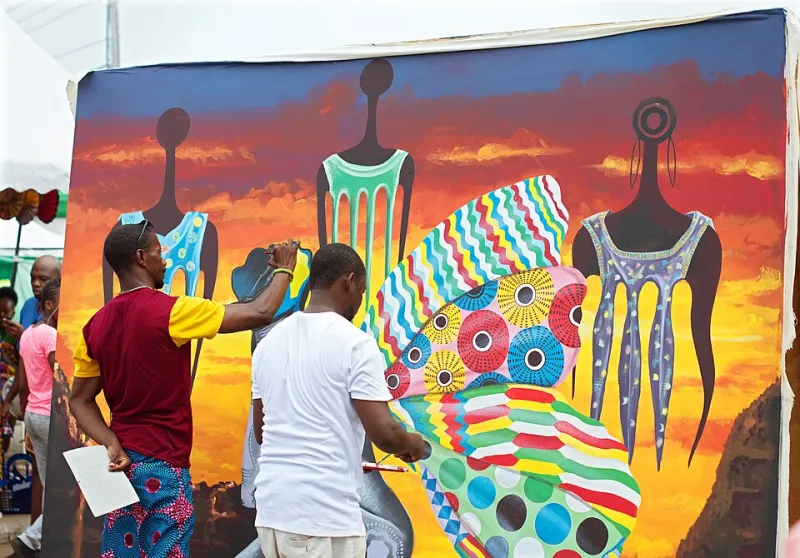
Photo: Kwameghana(Bright Kwame Ayisi), CC BY-SA 4.0, via Wikimedia Commons
There's a particular kind of silence that follows a creative catastrophe. The brush dragged wrong. The ladder wobbled. The resin poured too fast, or the spray can sputtered at exactly the wrong second. For a moment, the whole project feels ruined — weeks of planning, hours of setup, all of it suddenly at the mercy of a mistake.
And then, sometimes, something extraordinary happens instead.
It's one of the stranger paradoxes in artistic practice: the moment a creator loses control is occasionally the moment they produce their most arresting, most honest work. Not always. Not even often. But often enough that a growing number of artists are actively rethinking what "control" is even for.
The Myth of the Flawless Intention
Art school doesn't really prepare you for this. Most formal training — and most of the hustle culture around building a portfolio — centers on mastery. Know your tools. Refine your technique. Execute your vision with precision. The implicit message is that the gap between what you imagined and what you made is a failure of skill, something to be closed through repetition and discipline.
But that framework leaves almost no room for what artists who've been working long enough often describe as the most alive moments in their practice: the ones where the plan completely falls apart.
Muralist and installation artist Dana Ferris, based out of Philadelphia, remembers the piece that changed how she thinks about process. She was working on a large-scale outdoor commission — a community wall in Kensington — when an unexpected rainstorm hit mid-session. She'd been layering a tight geometric pattern in deep blues and ochres. The rain didn't just smear things; it pulled the pigment in directions she'd never have chosen, bleeding the edges into something that looked almost like topography, like a map of somewhere that didn't exist.
"My first instinct was to cover it," she says. "I literally had a tarp in my hand. And then I just... stood there in the rain looking at it. And I thought, this is actually more true to the neighborhood than anything I'd planned."
She left it. The piece was written up in three local publications. It's now one of the most photographed murals in the city.
When the Ladder Shifts
There's something almost literal about what happens when physical conditions change mid-work. Artists who operate at scale — muralists, installation builders, large-canvas painters — know that working from elevation changes everything. Your body is uncertain, your perspective is compressed, and your access to the surface is constantly negotiated. A shift in footing doesn't just change where you're standing; it changes what you can reach, what angle your arm moves at, what pressure you apply.
For Brooklyn-based painter Theo Marchetti, an accident with a scaffold plank led to what he now calls his "fault line" series. He was mid-stroke on a large abstract piece when the plank beneath him slid, sending his arm dragging diagonally across six feet of canvas in a single uncontrolled motion.
"I was furious," he says, laughing now. "I thought I'd destroyed it. I climbed down, looked at it from the floor, and the whole composition had changed. That one line was the most dynamic thing on the canvas. Everything else I'd done felt static compared to it."
Instead of painting over it, Marchetti built the rest of the work around that mark. The finished piece sold within two weeks of hitting his website. He's been chasing that energy ever since — though he's quick to note that deliberately trying to recreate an accident rarely works. "You can't fake the fear," he says. "That's what's in the line."
Surrendering the Blueprint
What separates artists who transform accidents into breakthroughs from those who just end up with ruined work? Most of the artists we spoke with pointed to the same thing: the willingness to pause before reacting.
That pause — the moment between "this went wrong" and "now I fix it" — is where the creative decision actually lives. And it requires a kind of ego suspension that doesn't come naturally to people who've invested heavily in a specific outcome.
Los Angeles-based ceramicist Yolanda Cruz describes it as "mourning the plan fast." When a kiln firing goes unexpected — a glaze runs, a crack forms, a color shifts in ways she didn't anticipate — she gives herself about thirty seconds to grieve the piece she thought she was making. Then she looks at what she actually has.
"Sometimes it's trash," she says honestly. "I'm not romanticizing every accident. But sometimes the kiln does something I never would have done on purpose, and I have to ask myself: is this actually worse, or is it just different from what I wanted?"
That question — worse, or just different — turns out to be one of the most generative questions an artist can ask.
The Science of Productive Failure
There's a reason this phenomenon keeps showing up across disciplines. Psychologists who study creativity have long noted that constraints and disruptions can force cognitive flexibility — the brain, unable to execute the original plan, starts generating alternatives it wouldn't have reached otherwise. Some researchers call this "productive failure," a state where the disruption of expected outcomes actually expands the solution space.
For visual artists, this plays out in viscerally physical ways. The materials themselves become collaborators rather than subjects. Paint behaves according to gravity, temperature, and surface texture — not according to intention. When something unexpected happens, the artist is suddenly in a conversation with those properties rather than trying to override them.
That shift — from override to conversation — is what a lot of the artists we talked to kept coming back to, in different words.
The Part Nobody Talks About
Here's the uncomfortable part: you can't build a practice around accidents. You can't pitch a client on "I'll start with a plan and then hopefully something will go wrong in an interesting way." The financial and professional realities of making art for a living require a baseline of intentionality and deliverability that doesn't leave much room for productive chaos.
And yet. Every artist we spoke with described some version of the same evolution: early in their careers, accidents were catastrophes. Later, they became data. And eventually, for some of them, they became something closer to a compass — a signal that they'd reached the edge of what their conscious planning could produce.
Dana Ferris put it plainly: "The work I'm most proud of has almost always involved a moment where I had to let go of what I thought I was making. Not because I planned to let go. Because I had no choice."
Maybe that's the real skill — not the ability to execute a vision perfectly, but the ability to recognize something worth keeping when it shows up uninvited. To look at the mess and ask, before reaching for the tarp: what if this is actually it?
Some of the best things ever made started with someone standing in the rain, watching their plan dissolve, deciding not to cover it up.