Burn the Brushes: What Happens When Artists Ditch Everything They Know
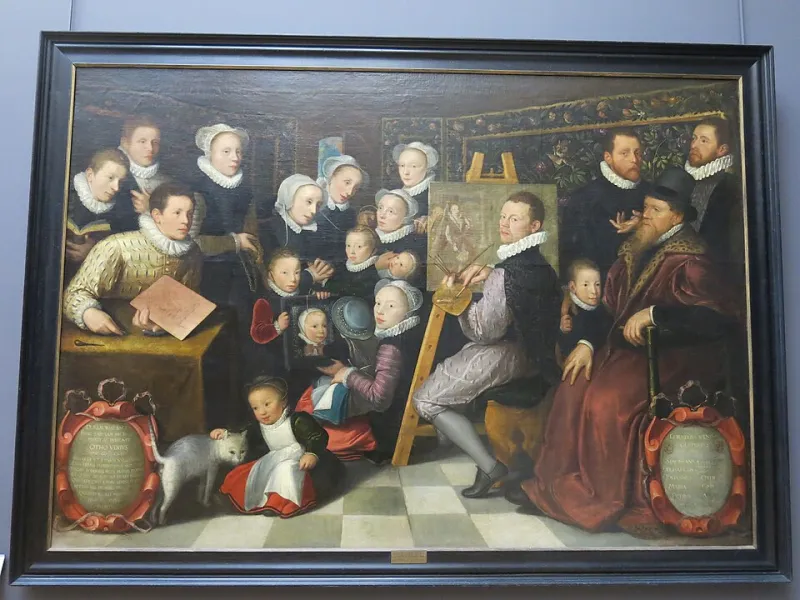
Photo: Tangopaso, Public domain, via Wikimedia Commons
There's a particular kind of stubbornness that keeps artists locked inside a medium long after it's stopped serving them. You've spent years — maybe decades — getting good at something. Your hands know the motions. The tools feel like extensions of your body. And then, quietly or all at once, the work starts to feel like a cage.
What happens next is the part nobody talks about enough.
Some artists push through, convincing themselves the problem is execution, not medium. Others take a break and come back hoping distance will fix the disconnect. But a growing number of working artists are doing something far more disruptive: they're walking away from what they're good at entirely, picking up something foreign and uncomfortable, and never going back.
This isn't failure. This is, for many of them, the most intentional creative decision they've ever made.
The Ceiling You Can't See Until You Hit It
Photographer and mixed-media artist Dana Reyes spent eleven years building a reputation shooting documentary-style portraiture across the American Southwest. Her work was exhibited in Santa Fe and picked up by editorial clients from coast to coast. By any measure, she had made it.
"I kept getting assignments that matched my aesthetic, and I kept executing them well," she says. "But I started realizing I was basically doing the same thing over and over with slightly different faces. The medium had given me everything it was going to give me."
What she noticed — and what many artists describe in similar terms — wasn't burnout exactly. It was more like a ceiling. A sense that no matter how technically refined her photographs became, they couldn't hold the emotional weight she was trying to put into them.
She started working with textile installation almost by accident, helping a sculptor friend prep a show. Within a week, she had ordered her own materials.
"I was terrible at it," she laughs. "I had no idea what I was doing. And that feeling — that total beginner's incompetence — was the most alive I'd felt making work in years."
The Psychology of Starting Over
There's something worth sitting with here. Most professional development culture tells artists to lean into their strengths, to specialize, to build brand recognition around a distinct style. And there's real logic to that. But it also creates a system where the cost of experimentation feels impossibly high.
When you've built an audience around oil painting, switching to sound installation isn't just a creative risk. It's a professional one. You're not just a beginner again — you're a visible beginner, which is a different and more vulnerable thing.
Psychologists who study creative cognition point to what's sometimes called "expert blindness" — the way deep familiarity with a skill set can actually narrow the range of solutions you're able to imagine. When sculptor Marcus Webb decided to abandon bronze casting after fifteen years to work exclusively with reclaimed industrial materials he'd never touched before, he described the shift as "thinking with different neurons."
"In bronze, I knew every variable," Webb explains. "I could predict outcomes. And that predictability was killing the work. With salvage materials, I had no idea what anything was going to do. I had to actually pay attention again."
His first show using reclaimed steel and found machine parts sold out. More importantly, he says, it was the first time in years he felt genuinely surprised by his own work.
The Grief Nobody Mentions
Here's the thing that doesn't get discussed enough when we romanticize these pivots: letting go of a mastered skill is genuinely painful. There's a grief to it that can feel disproportionate until you understand what's actually being lost.
Your medium isn't just a tool. It's a language. It's the specific way your hands have learned to translate interior experience into exterior form. Walking away from it — even voluntarily, even joyfully — involves a real mourning process.
Painter Solange Tremblay, who moved from large-scale abstract canvas work to performance and body-based art several years ago, describes a months-long period of creative paralysis during her transition.
"I kept going back to the canvas because it was safe," she says. "Not because I wanted to make paintings. Just because I knew how. And making something bad in a medium you understand feels less threatening than making something bad in a medium you don't."
She eventually stopped keeping painting supplies in her studio altogether. Not as punishment, but as permission. "If they were there, I'd use them as a crutch. I needed to not have the option."
The performance work she's made since then has toured festivals from New York to Los Angeles. The paintings, she says, she doesn't miss.
What the New Tool Actually Does
Across conversations with artists who've made deliberate medium switches, a few patterns emerge. Almost universally, the new medium forces a slower, more conscious relationship with the work. There's no muscle memory to fall back on. Every decision has to be made intentionally.
That friction, it turns out, is generative.
There's also something about the permission structure of being a beginner. When you're new to something, audiences and critics expect less. That reduced pressure can paradoxically free artists to take bigger conceptual swings than they ever would in their established medium, where every choice is scrutinized against a known body of work.
And perhaps most significantly, the new medium often illuminates what the old one was actually doing — what it could and couldn't carry, what it was uniquely suited for, and why the work had stalled. Distance clarifies.
The Ladder You Have to Climb Down First
At Paints on Ladders, we spend a lot of time thinking about the climb — the upward momentum, the ambition, the reach. But there's another kind of movement that's equally essential and far less celebrated: the deliberate descent. The choice to come down from a height you've already achieved and start the climb somewhere else entirely.
It takes a different kind of courage than going up. Going up, you're moving toward something. Coming down, you're moving away from something you've already earned, already proven, already know how to do.
The artists who've done it — and there are more of them than the art world typically acknowledges — describe it as the most clarifying creative experience of their lives. Not comfortable. Not easy. But clarifying in the way that only genuine risk can be.
Your best work might not be waiting inside the medium you've mastered. It might be waiting on the other side of the discomfort of putting those tools down.
Sometimes the wrong tool for the job is the one you've been using all along.