Ground Floor Art: The Creators Who Make Work Nobody Thinks to Look Down For
There's a running joke in the art world that everything worth seeing is either hung at eye level or elevated on a pedestal. Museums figured this out a long time ago. Galleries reinforced it. And somewhere along the way, artists internalized it too — the idea that good work gets lifted up, displayed at the correct height, and appreciated by someone standing at the correct distance with the correct amount of cultural fluency.
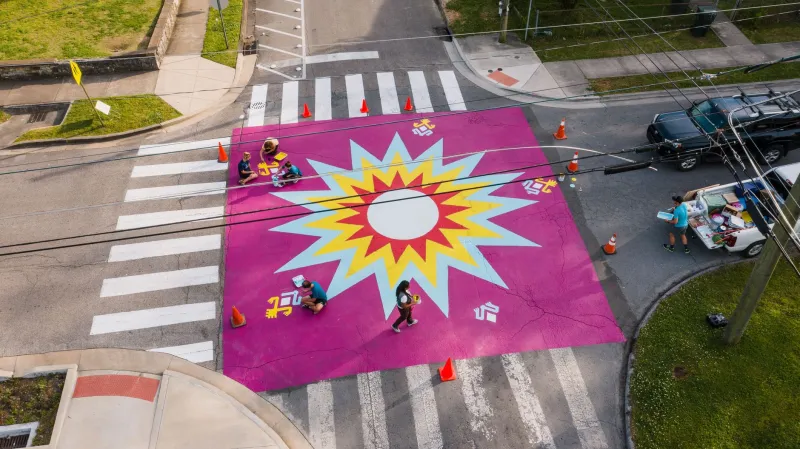
But a loose, growing, genuinely weird collective of artists across the US is done with that arrangement. They're making work for the ground. For the gutter. For the person who's looking at their shoes. And the results are some of the most quietly radical art being made right now.
The Tyranny of Eye Level
Walk through any major American city and you'll notice that public art defaults to the monumental. Big bronze figures on high plinths. Murals scaled for the person standing across the street. Sculpture parks designed to be photographed from the front, at the right angle, in good light. There's nothing wrong with any of that — but it does encode a specific assumption about who art is addressing and where that person is standing.
Artists working in what some are loosely calling "low-sightline" or "ground-perspective" practice are pushing back on that assumption pretty hard. The work isn't always literally on the floor. Sometimes it's tucked under a bridge, installed on the underside of a staircase, or embedded in sidewalk cracks. The common thread is that the viewer has to consciously redirect their gaze — downward, sideways, away from the expected — to find it.
That redirection is the whole point.
"When you ask someone to look in a direction they don't normally look, you're already doing something to their brain before the work even registers," says one Brooklyn-based installation artist who has spent the last three years embedding hand-painted ceramic tiles into the bases of parking structures in Bushwick. "The posture itself is the beginning of the experience."
Who Gets Found, and Who Gets Missed
There's something more than aesthetic going on here. Several artists working in this mode are pretty explicit about the social dimension of their choices.
Conventional public art — the stuff at eye level, in prominent plazas, with good lighting — tends to be made for people who are moving through a space with a certain kind of ease. Tourists. Office workers on lunch breaks. People who have time to stop and look. But a lot of people move through cities differently. People experiencing homelessness, who often look down as a matter of habit and survival. Kids, whose eye level is genuinely lower than the adult world assumes. People who are tired, distracted, or just trying to get through the day without incident.
Making work for those sightlines isn't charity. It's a reorientation of who the artist imagines as their primary audience — and that shift changes everything about what gets made and why.
A Chicago-based collective called Underneath the Obvious has been placing intricate, hand-lettered text installations on the undersides of elevated train platforms throughout the South Side since 2021. The phrases are drawn from oral histories collected from longtime neighborhood residents — small, specific memories that would never make it onto an official historical marker. You only see them if you're standing on the platform and happen to glance up at the structure above you. Most people don't. But the ones who do tend to stop for a while.
"We're not trying to interrupt your day," one of the collective's founding members explains. "We're trying to be there for the moment when you're already paused. Already looking somewhere you don't usually look."
Performance From Below
It's not just static installation work, either. A handful of performance artists have started building pieces specifically around non-traditional sightlines, including work designed to be viewed from below.
In Los Angeles, choreographer and visual artist Dani Morales developed a piece last year that was performed entirely on a glass-floored platform raised about four feet off the ground. The audience lay on mats underneath, looking up through the surface as the performers moved above them. The piece drew on the aesthetics of both aerial dance and surveillance — the performers could see the audience looking up at them, and the audience was acutely aware of being in the position of looking up at something that wasn't trying to be seen from that angle.
The discomfort was deliberate. "We're so used to performance being about the front," Morales says. "The proscenium. The frame. The thing you're supposed to be looking at. I wanted to take all of that away and see what was left when the only option was underneath."
What was left, by most audience accounts, was something genuinely strange and unexpectedly moving — a reminder that bodies look different from below, that power and vulnerability get scrambled when you change the angle, and that art experienced from an unusual physical position tends to stay with you differently than art consumed in the conventional upright stance.
The Practical Case for Looking Down
There's a more nuts-and-bolts argument for ground-level and low-sightline work, too: it's often cheaper, more accessible, and more durable than traditional installation.
You don't need a gallery to put something in a sidewalk crack. You don't need a permit to paint the underside of a staircase in a building where you already have access. Street-level work exists in a regulatory gray zone that gives artists more freedom to experiment without the overhead — financial and institutional — that comes with conventional exhibition.
That accessibility has made low-sightline practice particularly attractive to emerging artists who are skeptical of the gallery system and working with limited budgets. It's also made it a natural fit for artists who want their work to exist in genuine public space — not the curated, controlled "public" of a museum courtyard, but the actual street, with all the friction and unpredictability that entails.
What Happens When You Aim Low
Here's the thing about making art for overlooked perspectives: it changes what the art can be about. When you're not competing for the prime wall space, not angling for the Instagram shot, not designing for the person with the most cultural capital in the room — you get to make different decisions. Quieter ones. Stranger ones. More specific ones.
The artists working in this mode aren't making lesser work because they've aimed lower. They're making work that's pointed at a different kind of attention — the slow, accidental, slightly-off-balance attention of someone who just noticed something they weren't supposed to notice.
That's a particular kind of magic. And it turns out it's been sitting at your feet this whole time.