Nobody Asked You to Look Up: The Artists Making Work for the Wrong Angle
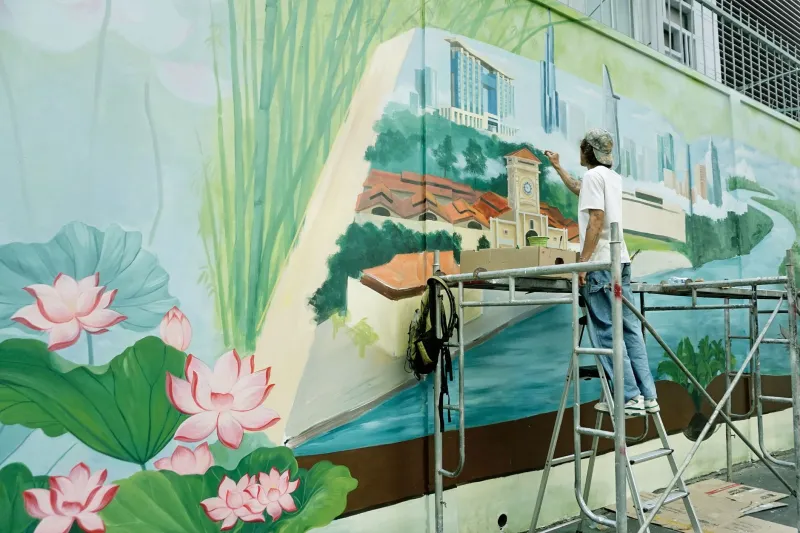
There's a particular kind of art experience that doesn't come with a press release or a velvet rope. It happens when you're late for work, cutting through an alley, ducking under a construction scaffold on a Tuesday morning with coffee in one hand and your phone in the other. You look up — maybe because of the light, maybe out of pure accident — and something stops you cold.
Somebody painted that. Somebody spent weeks on it. And they knew, going in, that most people would only ever catch about thirty percent of it through a gap in the plywood.
This is where some of the most interesting art in America is happening right now, and it's not getting nearly enough attention.
The Accidental Audience Is the Real Audience
Gallery culture runs on a certain kind of intentionality. You make a reservation, you show up during designated hours, you stand the right distance from the work and read the wall text. The viewer is prepared. The experience is curated almost to the point of being controlled.
But artists working in public space — particularly those creating for obstructed or constrained viewing conditions — are operating with a completely different contract. Their audience didn't opt in. The person looking up from the street didn't Google the artist's name. They're just there, physically moving through a city, and the work intercepts them.
That interception, chaotic and unplanned as it is, turns out to be incredibly powerful.
"The gallery viewer comes to the work," says one Brooklyn-based muralist who spent most of last year painting the undersides of elevated train structures in Chicago and Philadelphia. "My viewer is going somewhere else entirely. I have maybe two seconds to make them feel something before they keep walking. That pressure is brutal and it's also the most alive I've ever felt making work."
Constraint as Creative Engine
There's a long tradition in American public art of painters working around physical limitations — scaffolding grids, architectural interruptions, the way a fire escape bisects a wall. But the artists we're talking about here aren't just working around the constraint. They're working for it.
Think about what that actually demands. If you're painting a mural on the underside of a highway overpass in a city like Los Angeles or Atlanta, you know that most people will see it from a moving car, at speed, in peripheral vision. You can't rely on detail. You can't rely on text. You have to build something that communicates in a fraction of a second through color, shape, and sheer scale.
That's not a limitation. That's a completely different visual language.
Installation artists are pushing this even further. Some are building work specifically designed for the upward glance — pieces hung in building atriums, stretched across the tops of construction fencing, embedded in the ceilings of transit stations — that only fully reveal themselves when you happen to be standing in exactly the wrong place at exactly the right time. Catch it straight on and it looks like noise. Catch it from below at a weird angle and suddenly the whole thing resolves into something coherent and startling.
Performance for People Who Don't Know There's a Show
It's not just visual artists playing in this space. Performance makers are increasingly drawn to the idea of the unaware audience, too.
A performance collective based out of Portland spent the better part of two years staging durational pieces on rooftops visible only from certain upper floors of neighboring buildings. No announcement. No documentation pushed to social media until months after the fact. The only people who saw the work in real time were office workers who happened to glance out the window at the right moment, or residents of a nearby apartment building who might have assumed they were watching something mundane.
The collective describes their audience as "witnesses who don't know they're witnessing." There's something almost ethical in that framing — a refusal to demand attention, a willingness to let the work exist without being consumed.
What the Gallery Can't Give You
Here's the part that's genuinely hard for the traditional art world to sit with: work made for constrained, partial, or accidental viewing often lands harder than work made for the ideal viewing conditions of a white cube.
Part of that is surprise. When you're not expecting beauty and you find it anyway, the emotional hit is different. It's unguarded. You didn't have time to put on your art-appreciation face.
But part of it is also something more structural. When an artist designs for the wrong angle, they have to strip everything down to what actually matters. There's no room for work that only makes sense with context. There's no wall text to save you. The piece has to function on pure visual or experiential terms, and that discipline tends to produce something more honest.
"I stopped making work for critics a long time ago," says a muralist whose pieces on the underside of pedestrian bridges in Cincinnati have become quietly legendary in the city's arts community. "I make work for the person who's tired and not paying attention and then suddenly is. That's the viewer I care about."
The Ethics of the Uninvited Experience
It's worth pausing on something that doesn't come up often enough in these conversations: the question of consent.
Public art has always had an uneasy relationship with the idea that not everyone asked for it. Murals change neighborhoods. Large-scale installations can feel imposing. And work designed specifically for the unaware viewer carries its own set of questions. Is there something manipulative about engineering a moment of wonder for someone who didn't sign up for an art experience?
Most of the artists working in this mode seem to have thought hard about this, and their answer tends to be something like: the street already asks things of you without asking permission. Advertising does. Architecture does. The difference is that they're not trying to sell you anything or move you through a space efficiently. They're just trying to make the Tuesday morning commute a little less relentless.
That feels like a reasonable trade.
Looking Up in a Country That Mostly Looks Down
There's something specifically American about all of this, too. We are not, as a culture, known for looking up. We look at our phones. We look at the road. We look at the bottom line. The vertical dimension of our cities — the rooftops, the undersides of bridges, the tops of construction hoardings — tends to be treated as dead space.
These artists are making a claim on that dead space. They're saying it belongs to something other than pure utility, that the gap between where you're walking and where the sky starts is a place where something worth feeling can live.
You might not even notice it. That's fine. They made it anyway.