Stuck in the Middle (and That's Where the Magic Is): The Mid-Career Artists Nobody's Talking About

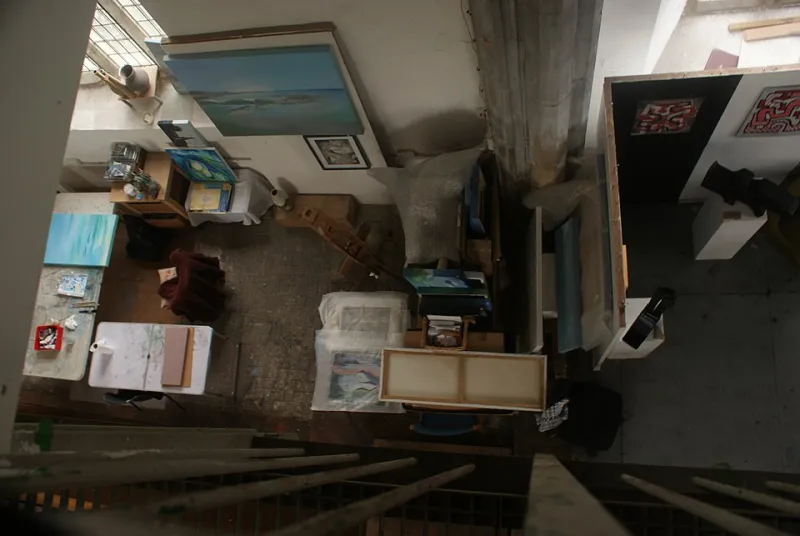
Photo: mid-career artist painting large canvas in studio, via m.media-amazon.com
There's a script the art world loves to follow. Act One: the wunderkind — fresh-faced, untrained instincts, raw talent that makes critics reach for their superlatives. Act Three: the legend — retrospectives, lifetime achievement nods, the kind of gravitas that gets you a wing named after you. But Act Two? The industry has been skipping that part for decades, and it might be the most interesting chapter of all.
Mid-career artists — loosely, those somewhere between eight and twenty years into serious practice — exist in a strange, underexamined zone. They're not new enough to be discoveries. They're not old enough to be monuments. And yet, if you actually pay attention to what's coming out of studios across the country right now, that in-between space is generating some of the most genuinely innovative, emotionally complex, structurally risky work being made.
We talked to painters, sculptors, and digital artists who've been at this long enough to know what they're doing — and who've used that knowledge not to play it safe, but to blow the whole thing up.
The Prodigy Trap (And Why It Leaves Everyone Else Behind)
The cultural obsession with early genius isn't just a quirk — it's a structural bias baked into how galleries scout, how grants get awarded, how press coverage flows. "30 Under 30" lists and emerging artist prizes dominate the conversation, creating a feedback loop where youth itself becomes the story. The work almost becomes secondary.
That framing does real damage. It tells artists that their window is narrow, that if they haven't broken through by a certain age they've somehow missed the boat. And it completely ignores the reality of how creative practice actually develops — slowly, through failure, through iteration, through the kind of self-knowledge that only comes from years of wrestling with your own limitations.
Melinda Osei, a mixed-media sculptor based in Detroit who's been working for about fourteen years, puts it bluntly: "I spent my first five years trying to make work that looked like I knew what I was doing. The next five, I figured out what I actually cared about. Now? I don't have anything left to prove, and that is the most dangerous creative position I've ever been in. Dangerous in the best way."
What a Decade of Work Actually Buys You
Here's the thing about surviving the early hustle: you come out of it with a toolkit that no MFA program can hand you. Mid-career artists have absorbed rejection without breaking. They've pivoted when a direction stopped working. They've watched trends rise and fall and learned — sometimes painfully — that chasing the wave is a losing game.
What that produces isn't cynicism. It produces clarity.
Jordan Pérez, a painter in Chicago whose large-scale figurative work has been quietly gathering serious institutional attention over the past three years, describes it as finally being able to hear yourself think. "Early on, there's so much noise — what the market wants, what your peers are doing, what the critics are rewarding that season. After enough years, a lot of that just... fades. You start making decisions from a different place."
That different place shows up in the work. Mid-career artists tend to take structural risks that younger artists often can't afford — conceptually or financially. They experiment with scale, medium, and form in ways that feel earned rather than provocative for provocation's sake. There's a confidence in the ambiguity, a willingness to let a piece be unresolved because they know the difference between unfinished and genuinely open.
The Freedom of Having Nothing Left to Lose (Yet)
Here's a paradox worth sitting with: mid-career artists are often in a more financially precarious position than either early-career artists (who have less to maintain) or late-career artists (who've built infrastructure). And yet that precarity — when it doesn't crush people, which it sometimes does, and that's worth acknowledging — can produce remarkable creative freedom.
Rachelle Tran, a digital and installation artist based in Los Angeles, spent her first decade building a reputation for clean, commercially viable work. Around year eleven, she started making pieces that were deliberately difficult — long-duration, spatially demanding, conceptually dense. The kind of work that doesn't sell easily. "I had built enough of a foundation that I could afford to confuse people for a while," she says. "Not forever. But long enough to find out what I was actually trying to say."
That window — long enough to experiment, not so long that you're coasting — might be the defining feature of the mid-career creative position. You've got roots. You haven't yet hardened into a brand.
Why the Industry Needs to Catch Up
The good news is that some corners of the institutional world are starting to notice. A handful of grants and residency programs specifically targeting mid-career artists have gained traction in recent years, acknowledging that the support infrastructure drops off sharply after the "emerging" label expires. Organizations like United States Artists have been deliberately shifting resources toward artists in this phase, recognizing that without intervention, a lot of genuinely significant work gets abandoned simply because the economics become unsustainable.
Galleries are slower to move — the commercial incentive to back proven names or fresh faces is real — but even there, some dealers are making the case that mid-career artists represent undervalued bets. The work is mature enough to hold up, the prices haven't peaked, and the most interesting formal developments are often still ahead.
The Ladder Looks Different From Here
One of the things that comes up again and again in conversations with artists at this stage is a changed relationship to the idea of "making it." The ladder metaphor that drives so much early-career anxiety — climb fast, don't slip, reach the top — starts to look pretty different from the middle rungs.
"I used to think about my career as vertical," says Osei. "Up or down, moving or stalling. Now I think about it more like... expanding outward. The work gets wider, not just taller."
That reorientation — from ascent to expansion — might be the most radical thing mid-career artists are doing. In an industry built around peaks and breakthroughs, they're quietly insisting that the most interesting creative territory isn't at the top of anything. It's in the sprawling, complicated, fully inhabited middle.
And if the rest of the art world is only now starting to look up from its obsession with the newest and the most legendary, well — these artists have been doing the work the whole time. They didn't wait to be discovered. They just kept climbing, and made the view from halfway up into something worth seeing.