Unclimbing: What Artists Find When They Deliberately Walk Away From the Top
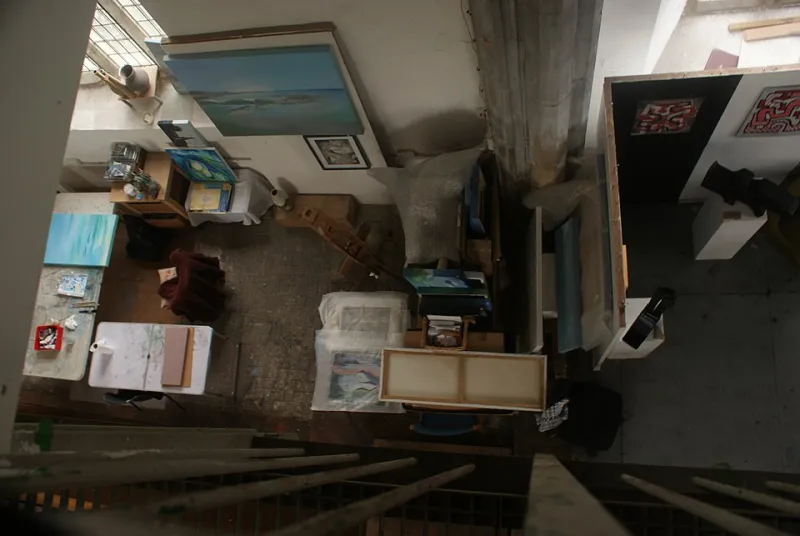
Photo: Robert Lamb , CC BY-SA 2.0, via Wikimedia Commons
There's a version of the artist's story we all know by heart. You grind. You struggle. You climb. You arrive. The narrative has a direction, and that direction is up. We celebrate the breakthrough show, the viral moment, the grant that finally came through. We frame the whole thing as ascent — and we treat any movement away from that peak as failure, retreat, or worse, irrelevance.
But what if we've been reading the ladder wrong?
A quietly growing number of artists across the US are doing something that makes their peers nervous and their collectors confused: they're coming down on purpose. Not because they failed. Not because the market dried up or the gallery dropped them. They're stepping back — from recognizable styles, from comfortable income streams, from the identities they worked years to build — because they realized the view from the top had started to look the same every single day.
And what they're finding on the way down is, frankly, more interesting than anything they discovered on the way up.
The Myth of Upward-Only Progress
We talk about creative careers the way we talk about real estate. Appreciation. Growth. Momentum. The language of accumulation is baked so deep into how we think about art-making that it's almost invisible. You build a body of work. You develop a signature style. You establish a reputation. Each of those words — build, develop, establish — implies a structure that only goes one direction.
But artists aren't buildings. And creative growth doesn't actually behave like compound interest.
The painter who's been selling the same moody coastal landscapes for a decade isn't growing — they're manufacturing. The sculptor whose studio practice has calcified into a reliable formula isn't making art — they're running a production line. The work looks successful from the outside. It sells. It gets shown. But inside the studio, something has gone quiet.
That quiet is the thing a lot of artists are finally starting to listen to.
What Stepping Back Actually Looks Like
For Brooklyn-based mixed media artist Dara Hollins, stepping back meant turning down a solo show at a mid-size Chelsea gallery — the kind of opportunity she'd been working toward for six years. "I'd gotten so locked into a particular visual language that the new work I was making felt like a greatest hits album," she says. "I knew what I was going to make before I made it. That's not art. That's craft at best, and decoration at worst."
She spent eight months making work she never showed anyone. Smaller. Messier. Less resolved. She gave herself permission to be bad at things again, which meant deliberately working in mediums she had no fluency in — ceramic, sound, textile. "Coming down from the thing I'd built felt terrifying for about two weeks," she says. "Then it felt like oxygen."
In Los Angeles, muralist and public artist Marco Reyes walked away from a lucrative commercial mural pipeline — the kind of steady work that kept him booked eighteen months out — to go back to making small paintings in his apartment. No client briefs. No brand guidelines. No Instagram documentation strategy. "I'd turned myself into a service," he says. "I needed to remember what it felt like to make something that nobody asked for."
These aren't isolated stories. They're part of a pattern.
The Pedagogy of Dismantling
Here's what nobody tells you about creative habits: the ones that got you somewhere are often the exact same ones that will keep you stuck. The bold compositional moves that made your early work exciting become tics. The color palette that felt instinctive starts to feel like a brand standard. The subject matter that once meant something to you personally becomes a product category.
The only way to break those habits isn't to push through them — it's to dismantle the structure that made them feel necessary.
This is where the descent becomes pedagogical. When you come down from the thing you've built, you get to examine it from angles you couldn't see while you were standing on top of it. You see which parts of your practice were genuinely yours and which parts were shaped by market pressure, peer comparison, or the accumulated weight of other people's expectations. You see what you were avoiding. You see what you were compensating for.
It's uncomfortable as hell. It's also irreplaceable.
The art schools don't really teach this. The mentors mostly don't model it. The art world's economy actively punishes it — because galleries and collectors need consistency, and consistency is the enemy of genuine reinvention. So when artists choose the descent anyway, they're doing it against the grain of every incentive structure around them.
That takes a specific kind of courage that we don't talk about enough.
Losing What You Were to Find What You Are
There's a concept in Zen practice sometimes described as "beginner's mind" — approaching something you know well as if you're encountering it for the first time. It's easy to romanticize. It's genuinely hard to practice, especially when your livelihood is tied to the expertise you've spent years accumulating.
But artists who've made the deliberate descent tend to describe something close to it. A return to not-knowing. A willingness to be confused, to make ugly things, to sit with the discomfort of not having answers.
Dara Hollins puts it plainly: "I had to lose the version of myself that knew how to make a Dara Hollins piece before I could figure out what I actually wanted to make next."
That loss isn't nothing. It's grief, sometimes. It's disorientation. It's the very specific anxiety of watching something you worked hard to build recede in the rearview mirror while the road ahead is still dark.
But the artists who've done it — who've come down, cleared the decks, and started again from something closer to zero — almost universally describe the work that came after as more alive than anything they made at the top.
Progress Has Always Had More Than One Direction
The ladder metaphor, it turns out, is the problem. Ladders only go two ways. But creative practice is more like a landscape — you can move in any direction, and sometimes the most important terrain is behind you.
Coming down isn't giving up. It's not failure dressed in philosophical language. It's a form of creative courage that the art world is deeply bad at honoring, because it doesn't photograph well and it doesn't fit the ascent narrative we've all agreed to tell.
But the artists doing it know something the rest of us are still learning: the view from the bottom of a new climb is always more interesting than the view from the top of an old one.
Sometimes you have to come all the way down to remember why you picked up the brush — or the chisel, or the camera, or whatever strange tool it is that makes you feel most like yourself — in the first place.
And that? That's worth every step of the descent.