One Rung at a Time: Why Working in Tiny Increments Makes Artists Think Bigger
There's a particular kind of stubbornness in an artist who refuses to rush. Not the procrastinator's stubborn — not the kind that avoids the canvas because the blank space feels too loud. This is something different. This is the person who decides, before a single mark gets made, that the work will only ever move forward in small, deliberate pieces. One layer. One session. One rung.
And weirdly? That's where some of the most surprising art is happening right now.
The Myth of the Big Swing
We love the mythology of the artist who tears into a piece like a storm — paint flying, energy crackling, some primal force channeled from the cosmos directly onto a 10-foot canvas. It's cinematic. It's very easy to make a documentary about. But for a lot of working artists, that model produces work that feels more like a performance of creativity than the actual thing.
Incremental process flips that script entirely. Instead of building toward one explosive release, you're building — literally building — in stages that each demand their own attention. The constraint isn't a limitation you're trying to work around. It's the whole point.
Think about the logic of a ladder. You can't skip rungs safely. Each step has to hold before you move to the next. Artists who've internalized that rhythm talk about how it fundamentally changes their relationship to decision-making. When you know you can only add one layer today, you stop trying to solve the whole piece at once. You solve this moment. And then you come back tomorrow and solve the next one.
Slow by Design
New York-based textile artist Miriam Osei-Bonsu spent three years building a single large-scale wall installation using a process she describes as "intentional withholding." Each week, she permitted herself to add only what fit within a specific time window — no more, no less. The finished piece, which debuted at a Brooklyn warehouse show in 2023, contained thousands of hand-knotted elements. But the thing that struck viewers wasn't the density. It was the coherence. Every section felt considered. Nothing felt thrown in.
"When you can't rush, you stop second-guessing," Osei-Bonsu has said. "You make the decision that's right for today, and you trust that tomorrow's decision will be right for tomorrow."
That trust is the hard-won gift of incremental work. It doesn't come fast — which, again, is kind of the whole point.
The Vertical Build
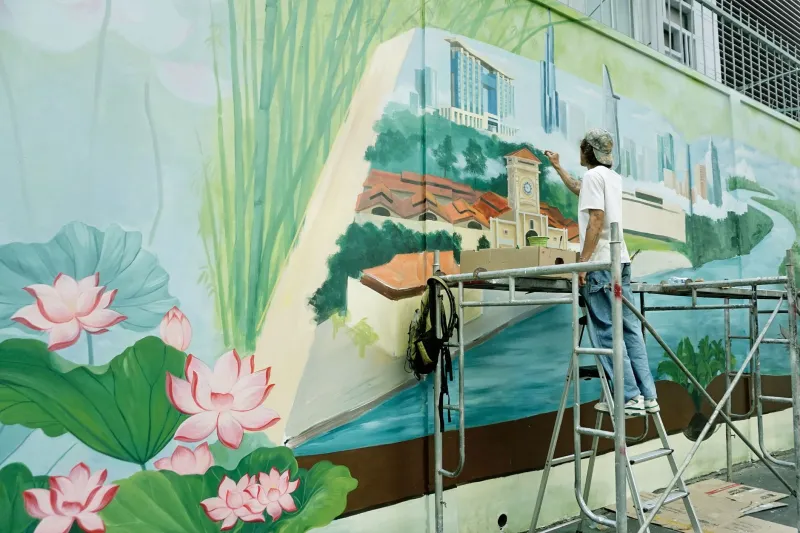
For muralists and installation artists working in physical space, the incremental approach often has a literal dimension. You can only reach so high without moving the equipment. You can only see so much of the composition from any one vantage point. Working vertically over days or weeks means the piece is always partially hidden from you — always partly unknown.
Chicago muralist Davi Reyes describes this as "painting in faith." When you're eight feet up working on a section that won't visually connect to the ground-level work until the scaffold comes down, you're making decisions based on memory, instinct, and a kind of spatial trust that open-studio work rarely demands. The constraint of access forces a different kind of thinking. You're not just problem-solving. You're predicting. You're imagining forward.
Reyes says the first time he stepped back from a completed wall and saw the whole thing for the first time — really saw it, as a viewer rather than a worker — he cried. Not because it was perfect. Because it was coherent in a way he couldn't have engineered from the ground. The increments had done something he hadn't planned.
Why Limitation Unlocks Rather Than Locks
This is the counterintuitive heart of the whole thing: constraints that seem like they should produce smaller, safer work often produce the opposite. When you can't do everything at once, you stop trying to. You stop performing ambition and start practicing it.
Cognitive science has been interested in this for a while. Research on "creative constraints" consistently shows that defined limits — in time, material, access, or method — push people toward more original solutions than open-ended briefs. The brain, faced with infinite options, often retreats to the familiar. Faced with a narrow corridor, it has to get creative about what fits.
For visual artists, this translates in ways that are almost physical. The painter who can only work in 20-minute sessions starts to understand what 20 minutes of attention actually looks like on a surface. The sculptor who can only add one element per day starts to understand weight and relationship and negative space in ways that a marathon studio session might never reveal.
It's the difference between reading a chapter a night and binge-watching. One of those leaves you with something you actually remember.
The Patience Problem (And Why It's Worth Solving)
Here's the honest part: this approach is genuinely hard to sustain in a culture that rewards output. Instagram doesn't care that your piece took eight months to layer. The algorithm isn't interested in your process unless you're filming it in a way that performs well in the first three seconds. The art market moves fast, and the pressure to produce, post, and move on is real.
Artists working incrementally have to make a kind of peace with invisibility — at least temporarily. The work isn't done. It can't be shown. It lives in your studio or on your wall or in your sketchbook, accumulating meaning in private.
But the artists who've committed to this say the payoff isn't just in the finished piece. It's in what the process does to you as a thinker. Slow, staged work trains a kind of attention that carries over into everything else. You start noticing increments everywhere — in relationships, in conversations, in the way a neighborhood changes block by block. The ladder becomes a way of seeing, not just a way of working.
What the Rungs Are Actually For
A ladder isn't really about getting to the top. That's the destination, sure, but the rungs are the mechanism — the thing that makes the height possible. Without each individual step holding firm, the whole structure collapses.
Artists who've built their practice around incremental work understand this in their bones. The rung isn't an obstacle between you and the finished piece. It's the piece. Each stage, each layer, each session that ends before the work is complete is doing something that the final reveal can't do on its own.
It's building the capacity to hold the whole thing up.
And if that takes months? If it means stepping away every day before you're satisfied, coming back tomorrow, and doing it again? Then that's the practice. That's the art. One rung at a time, all the way up.